

The Only Test to Detect EPA
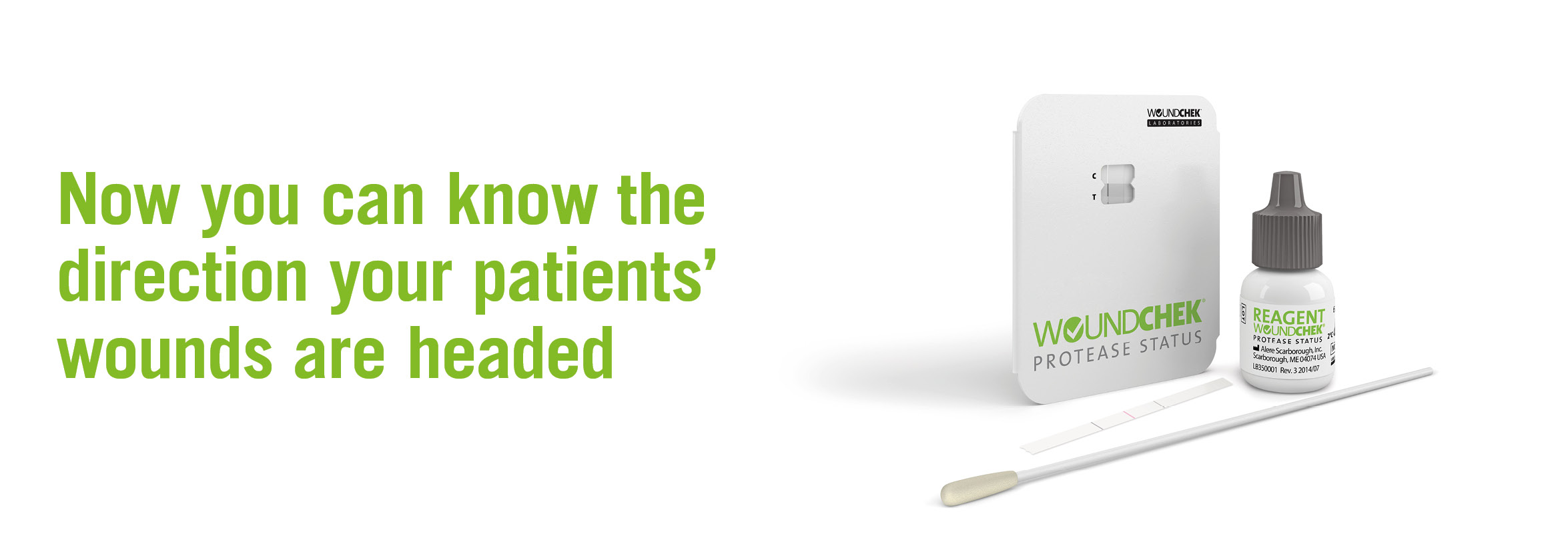
Developed to aid wound assessment and help clinicians target advanced wound care therapies more effectively, WOUNDCHEK™ Protease Status is able to detect EPA (elevated protease activity). As there are no visual cues for EPA, wounds with EPA have so far gone undetected1Snyder R. et al. A survey: The importance of proteases in wound healing and wound assessment. Poster, Wounds UK 2011..
WOUNDCHEK™ Protease Status will help clinicians establish within minutes which wounds may most benefit from a protease modulating therapy, ensuring appropriate and targeted use of these therapies.
WOUNDCHEK™ Protease Status product sizes — Now available in countries accepting CE mark!
|
PRODUCT CODE |
DESCRIPTION |
CONTAINS |
|
350006 |
WOUNDCHEK™ Protease Status |
6 tests (all material needed) |
|
350010 |
WOUNDCHEK™ Protease |
3 elevated result and |
Videos


Disclaimer:
The product information on this page is not intended for, or to be used by health care professionals or users in the United States
Evidence



Posters & Articles
 Serena TE, et al, 2016. Defining a new diagnostic assessment parameter for wound care: Elevated protease activity, an indicator of nonhealing, for targeted protease-modulating treatment
Lazaro J., et al, 2016. Elevated levels of matrix metalloproteinases and chronic wound healing: an updated review of clinical evidence
Izzo I., et al, 2014. High matrix metalloproteinase levels are associated with dermal graph failure in diabetic foot ulcers
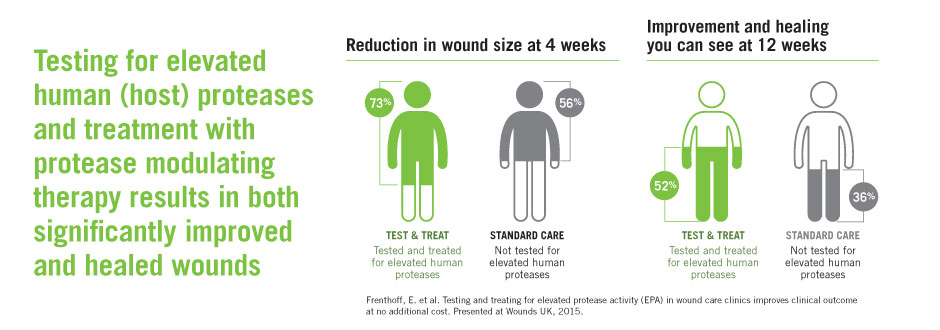
Frenthoff, E. et al. 2015. Testing and treating for elevated protease activity (EPA) in wound care clinics improves clinical outcome at no additional cost
Uccioli, L. et al. 2014. The presence of elevated protease activity (EPA) influences the integration of dermal grafts in diabetic foot ulcers
Gibson, M. et al. 2013. Testing chronic wounds for EPA. The benefits of testing all wounds, whether assessed as healing or non-healing
Ivory, 2013. The cost implications of implementing Woundchek Protease Status into clinical practice
Ivory, 2013. Assessing chronic non healing wounds for elevated protease activity
Anichini, R. et al. 2013. Detecting and treating Elevated Protease Activity (EPA) in chronic diabetic wounds
Duteille, F. 2013. Evaluation of the use of point-of-care test for proteases to identify patients with increased risk of skin graft failure
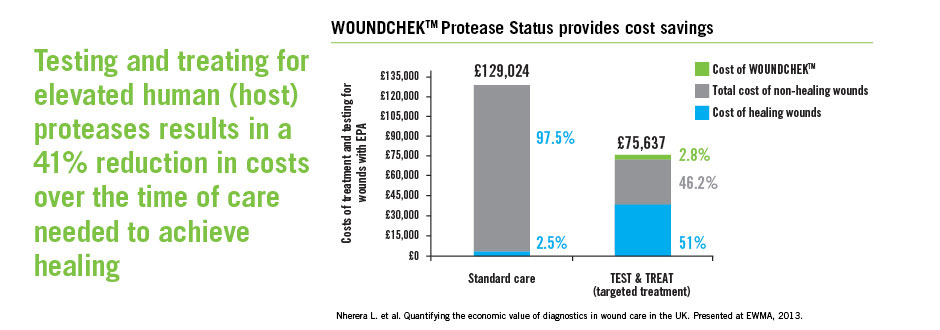
Nherera, L. et al. 2013. Quantifying the economic value of diagnostics in wound care in the UK
International case series: Using Promogran/Promogran Prisma on wounds with elevated protease activity: case studies. London: Wounds International, 2013.
Young, T. 2012. Using a protease test to inform wound care treatment decisions
Haycocks, 2012. Assessing chronic diabetic foot wounds for elevated protease levels
Hodgson, 2012. Clinical skills of tissue viability nurse versus Woundchek to detect elevated protease activity (EPA)
Serena, T. et al. 2012 Preliminary results: Testing for elevated protease activity in clinical practice
Johnstone, 2012. Case Studies: Testing for and treating EPA
Cullen, B. et al 2012. Targeted use of Collagen/ORC improves clinical outcome
Serena, T. et al. 2011. Protease activity levels associated with healing status of chronic wounds
Snyder, R. et al. 2011.The importance of proteases in wound healing and wound assessment
Consensus Documents
Diabetic Foot Ulcers: Prevention, Care and Treatment Spanish Diabetes Foundation, 2014
Die tolle eines proteasen schnelltests in der wunddiagnostik DACH, 2013
Using a diagnostic tool to identify elevated protease activity levels in chronic and stalled wounds USA, 2013
EPA made easy, Wounds International, 2013.
Protease diagnostic in wound care UK, 2012
Role of proteases in wound diagnostics International, 2012
Significato e valutazione delle proeasi nel processo di riparazione tessutale Italy, 2012
The role of a point-of-care protease activity diagnostic test in Canadian clinical practice Canada, 2012
World Union of wound healing societies consensus document International 2012
Symposia
Dr. Läuchli, Dr. Anichini, Dr. Dowsett, and Prof. Duteille, EWMA 2013 EPA, guiding treatment decisions for improved clinical results and cost effective care
Dr. Serena, Dr. Fletcher, and Dr. Läuchli, EWMA 2012 Testing for EPA, the arrival of wound diagnostics
Dr. Thoms, Training Event 2012 Proteases: Background, Assessment, and Treatment of EPA in chronic wounds (in German)
Disclaimer:
The product information on this page is not intended for, or to be used by health care professionals or users in the United States
Active Infection
Bacteria are in a pathogenic state when they are either in the process of, or they are capable of, causing disease, i.e. infection. One measure of pathogenicity is the production of enzymatic virulence factors called bacterial proteases1Lebrun I, Marques-Porto R, Pereira AS, Pereira A, Perpetuo EA. Bacterial toxins: an overview on bacterial proteases and their action as virulence factors. Mini-reviews in medicinal chemistry 2009; 9 (7): 820-8.. A number of known proteases have been characterised from some of the frequently reported bacteria in chronic wounds2Koziel J, Potempa J. Protease-armed bacteria in the skin. Cell Tissue Res. 2012; 351(2): 325-37.,3Potempa J, Pike RN. Corruption of innate immunity by bacterial proteases. J. Innate Immun. 2009; 1: 70-87.. The impact of bacterial proteases has been documented in a range of acute and chronic medical conditions, including cystic fibrosis, eye infections and wound infections3Potempa J, Pike RN. Corruption of innate immunity by bacterial proteases. J. Innate Immun. 2009; 1: 70-87.,4Twining SS, Kirschner SE, Mahnke LA, Frank DW. Effect of P aeruginosa elastase, alkaline protease, & exotoxin A on corneal proteinases and proteins. Invest. Ophthalmol. Vis. Sci. 1993; 34(9): 2699-712..
The detection of bacterial protease activity in a chronic wound would be indicative of the presence of bacterial pathogenesis which is a precursor to clinical signs and symptoms of infection5Thomson PD, Smith DJ. What is infection? Am. J. Surg. 1994; 167(No. 1A): 7S-10S.,6Dow G, Browne A, Sibbald RG. Infection in chronic wounds: Controversies in diagnosis and treatment. Ostomy Wound Management 1999; 45 (8): 23-40..
Bacterial pathogenesis is undesirable since, at this stage, the wound is in a part of the wound infection continuum that typically requires intervention.
WOUNDCHEK™ Bacterial Status — Coming Soon!
Evidence
Posters & Articles
Serena, T. et al. 2017. A Rapid Point of Care Test for Bacterial Protease in Chronic Wounds is Predictive of Amputation Risk
Serena, T. et al. 2015. Bacterial proteases: A marker for a 'state of pathogenesis' in chronic wounds
Serena, T. et al. 2015. Bacterial protease activity in chronic wound fluid, a potential indicator of pathogenicity even in the absence of overt signs of infection.
Benson, R. et al. 2013. Bacterial protease activity, an indicator of bacterial pathogenicity in chronic wounds even in the absence of overt clinical signs.
Consensus Documents
Wound Infection in Clinical Practice, International Wound Infection Institute, 2016
BPA Made Easy Wounds International, Serena T., et al, 2016
The Use of a point-of-care test for bacterial protease activity in chronic wounds Wounds International 2015, Vol 6 Issue 4
Symposia
content coming soon.
Disclaimer:
The product information on this page is not intended for, or to be used by health care professionals or users in the United States
Areas of Interest
The strategy of WOUNDCHEK™ Laboratories is to be the leading and dominant enterprise in wound care diagnostics by providing medical professionals with the diagnostic information to:
-
Identify wounds which are not healing
-
Intercept issues and early warnings that cause poor wound healing or initiate wounds
-
Aid in determination of best therapeutic routes
-
Monitor the effectiveness of a course of treatment
Clinical experts identified numerous markers that could form the basis of new diagnostic tools for use in wound care1World Union of Wound Healing Societies (WUWHS). Principles of best practice: Diagnosis and wounds. A consensus document. London: MEP Ltd, 2008.(see slide above).